As an Amazon Associate, we earn from qualifying purchases. This post contains affiliate links – if you buy through them, we may earn a commission at no extra cost to you.
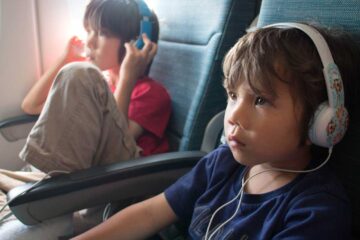
There’s no single best kids headphone for a plane. There’s a best one for your kid, your flight and your habits. Three things decide it: how old your child is, whether you need active noise cancelling for engine roar, and whether you want a wired backup for takeoff and landing. These picks differ on exactly those points — battery, volume limits, fit and how they connect. The two that split most buyers are the iClever BTH12, for long battery and a low toddler volume mode, and the JBL Junior 470NC, for active noise cancelling with app-based parental control.
1. iClever BTH12 Kids Bluetooth Headphones 85H Playtime with LED Lights

Best for: families who want one pair to last a long trip
The BTH12 is built around battery and volume control. The listing states 85 hours of playtime and a 10-minute USB-C charge that gives 7 hours — that covers a long-haul flight and the days around it without hunting for an outlet. Volume is limited at 74 or 85 dBA, switched with combination keys so a kid can’t nudge it by accident. That combination is the reason it suits a family that flies a few times a year and wants the same pair to work at home after.
The trade-off is the shape of the thing. It’s an over-ear Bluetooth 5.2 headphone with a built-in mic, reinforced material for drops and folding, and AUX as a wired backup. There’s no active noise cancelling here, so engine drone is blocked by the ear cushions rather than by electronics.
Good if:
- You want a wired AUX option for the parts of a flight where Bluetooth isn’t allowed
- Your kid needs a lower volume setting than the standard limit
- You’d rather charge once than pack a power bank
Skip it if:
- Your child is bothered by engine noise and needs it actively cancelled
- You want to set and monitor volume limits from your own phone
2. JBL Junior 470NC

Best for: noisy cabins and parents who want control
Active Noise Cancelling is the whole point of the 470NC. The listing says it shuts out distracting external noise so kids can listen at a lower volume — on a plane, that’s the difference between a child turning the volume up to hear a movie and a child hearing it at a safe level. The headphones never exceed 85dB, and you can set a lower limit through the JBL Headphones app.
That app is the second half of the pitch. It gives real-time reports on how long your kid listens and at what volume, plus daily and weekly summaries, and a PIN code so your settings stay put. For a parent who wants to know rather than guess, that’s a real feature. The catch: this control lives on your phone, so the setup depends on you, not on the child.
Good if:
- You’re flying often and want engine noise actively reduced
- You want to cap both volume and daily listening time
- You’d like a report on how loud your kid actually listens
Skip it if:
- You don’t want to manage settings through an app
- Your kid is too young for an over-ear fit to sit still
3. iClever BTH20 Active Noise Cancelling Headphones

Best for: kids who fly and need serious noise blocking
The BTH20 is the flight specialist. It has two noise reduction modes with a maximum depth of 40dB, and the low mode gives gentler ear pressure for kids who are sensitive to that feeling. The high mode targets engines and mechanical noise. One thing to plan around: the listing states ANC isn’t available over a wired connection, so the noise cancelling only works in Bluetooth mode.
Battery is 60 hours with ANC off and 35 hours with it on, with a 10-minute Type C charge giving 5 hours. Volume sits at 80dBA with iClever’s Sound Refiner, which the listing says lowers volume in the frequency range most likely to damage hearing. The ear cups rotate 90 degrees and the headband has 10 levels of adjustment, sized for kids aged 3 and up.
Good if:
- Your child is sensitive to cabin noise and needs it cut down
- You want a gentler noise-cancelling mode for sensitive ears
- Your kid is 3 or older and needs an adjustable fit
Skip it if:
- You want noise cancelling while plugged in with a cable
- Your child is under 3
4. Belkin SoundForm Mini 2 Kids Headphones

Best for: siblings sharing one screen on a long flight
RockStar Mode is the feature that earns this pick its place. It lets kids share audio with a sibling, friend or classmate, wired or wirelessly, so two children can watch one tablet without a splitter. On a flight, that’s the difference between one screen keeping two kids quiet and two kids arguing over one pair. The 3.5mm jack also allows an individual wired connection.
Battery is 55 hours, which the listing frames as one charge a week at 7-8 listening hours a day. Sound runs through 40mm drivers with an 85dB volume limit, and there’s a built-in mic for calls and virtual learning. The design folds flat for a bag, and the adjustable on-ear headband with kid-sized cushions is made to fit as toddlers grow. The trade-off is on-ear rather than over-ear — less coverage for blocking engine noise.
Good if:
- Two kids will be passing a single tablet or phone back and forth on the trip
- You want both wired and wireless in the same set of headphones
- You want a pair that folds flat in a carry-on
Skip it if:
- You need active noise cancelling for the engine roar
- Your child prefers full over-ear coverage
5. iClever BTH22 Toddler Headphones

Best for: toddlers on their first flight
The BTH22 is aimed at the youngest flyers. It weighs 0.33lb, has rotating ear cups and a 10-level headband, and the listing sizes it for children aged 2 and above. Volume is limited below 85dBA, and pressing “+” and “-” together switches to a 74dBA mode the listing calls tailor-made for toddlers. That second setting is the reason it works for a two-year-old whose ears are new to headphones.
Battery is 60 hours through Bluetooth 5.4, and when it runs out the included 3.5mm cable keeps the audio going — useful on a flight where you’ve forgotten to charge. The ABS build is stated as 50% stronger than regular material and free of BPA and PVC, with an enhanced button structure that the listing says doubles the number of presses it survives.
Good if:
- Your child is around 2 and needs a smaller fit
- You want a dedicated lower volume mode
- You want a cable backup for a dead battery
Skip it if:
- Your child is older and needs a larger headband fit
- You want noise cancelling for the cabin
6. Acer Kids Bluetooth Headphones

Best for: kids who carry their own bag to school
This Acer pair is about weight and rough handling. The listing puts it at 6.63 ounces, with soft memory foam ear cushions and an adjustable headband. A reinforced headband hinge is stated to handle school bags and playgrounds, and the whole thing folds for storage. For a child who packs their own carry-on, that combination matters more than any single spec.
Volume limiting is 85/94dB, which is a wider range than most picks here — the higher setting is for noisy places. Battery is 60 hours with a 5-minute USB-C charge giving 2 hours, and a 3.5mm cable is supported for wired listening. Bluetooth 6.0 handles the connection, with a built-in mic for calls and online classes. It’s CPSIA certified and BPA-free.
Good if:
- Your kid is hard on their gear and needs a reinforced hinge
- You want a lighter over-ear pair for all-day wear
- You want a higher volume option for noisy cabins
Skip it if:
- You want a strict single volume ceiling with no higher mode
- You need active noise cancelling
7. JoySpark Kids Bluetooth Headphones Over-Ear

Best for: online classes and calls as much as travel
The mic is the reason to look here. JoySpark uses Bluetooth 5.3 with one-button control for play, pause and answering or ending calls, and the built-in microphone is aimed at studying, homework, class and playtime. If your kid uses the same headphones for a flight and for school, that one-button call handling gets used more than you’d think.
Sound comes from a 40mm speaker unit with an 85/94dB limit and combination keys to stop accidental volume changes. Battery is up to 60 hours, with a 3.5mm backup jack for when it runs down. Comfort comes from memory foam cushions and a fully adjustable padded headband. The listing also states a 24-hour response window for support emails.
Good if:
- Your child joins calls or online classes with the same pair
- You want simple one-button call control
- You want a wired backup jack
Skip it if:
- You need noise cancelling on the plane
- You want app-based volume monitoring
8. JBL Junior 320 Kids Headphones

Best for: kids who don’t need a battery at all
This is the wired pick, and that’s a feature on a plane. There’s no battery to charge and no pairing to do — plug into the seat-back jack or a tablet and it works. The listing states the headphones never exceed 85dB, so the safe volume is built in rather than switched on. A built-in mic handles calls with teachers, friends and family.
Comfort is a 12mm padded headband with round earcups for better grip and less sound leakage, sized for little heads on long school days or travel. The design folds flat for a bag, and a JBL sticker set lets a kid make the pair their own. No Bluetooth, so your child is tethered to the device by the cable.
Good if:
- You want zero charging and zero pairing on travel days
- Your kid is rough on wireless gear
- You want a fixed safe volume with nothing to adjust
Skip it if:
- Your child wants to move around untethered
- You need noise cancelling
9. iClever HS19 Kids Headphones with Cord

Best for: first-time buyers who want the simple version
The HS19 is the simplest thing here: a wired over-ear pair with a cord, an 85dBA limit and a built-in mic. It works with anything that has a 3.5mm jack — Chromebook, Kindle Fire tablet, Switch, iPad, laptop or PC, per the listing. Nothing to charge, nothing to pair, nothing to configure. For a first pair, that removes most of the ways a flight can go wrong.
The share port is the standout extra. A second headphone plug goes into the sharing jack so two kids can listen to one device with no splitter or special cable. Sound comes from 40mm drivers, the earmuffs are ultra-soft, and the design folds for packing. iClever states 24-hour customer support.
Good if:
- You want headphones that work with an old tablet or a seat-back jack
- Two kids will be watching the same screen
- You want no battery and no Bluetooth setup
Skip it if:
- Your child needs wireless freedom
- You want volume settings below the standard limit
10. Toddler Headband Fox

Best for: toddlers who won’t wear ear cups
This one is a different shape, and that’s the point. There’s no hard band and no ear cups — flat speakers sit in a sewn-in pocket of a stretchy fabric headband. The listing says a toddler can lean back in a car seat or nap on a flight, and it doubles as a sleep mask. For a child who pulls regular headphones off, that’s the whole argument.
It ships in Kids Mode with volume limited by default, and a Normal Mode raises volume for noisy places like a plane or a road trip. Battery is up to 16 hours of Bluetooth, with an included cable for a 3.5mm jack when it runs low. The headband is machine-washable once you remove the electronics, and a mesh travel bag is included. Share Mode links two CozyPhones 4.0 headsets to one device, but each is sold separately.
Good if:
- Your toddler refuses earbuds or bulky headsets
- You want something that works for naps as well as movies
- You want a washable, soft fit for a small head
Skip it if:
- Your child is older and wants a normal headphone shape
- You need noise cancelling
Also Worth Considering
The noot products K11 Kids Headphones is a wired pair with a 3.5mm jack in navy and teal. If you want the simplest possible connection for a young child and don’t need Bluetooth, it belongs on your shortlist.
The Candy Bila Wired Kids Headphones is an over-ear wired option aimed at school use for boys and girls. It suits a child who needs one pair for the classroom and the plane, with no charging to remember.
The Belkin SoundForm Mini Kids Headphones is the earlier SoundForm Mini — wireless and wired with 30 hours of playtime, aimed at school. If you like the Belkin approach but don’t need the longer battery of the Mini 2, it’s worth a look.
Where These Overlap
Several of these are close enough that the choice barely matters. The iClever BTH12, Acer Kids Bluetooth and JoySpark Kids Bluetooth all land in similar territory: over-ear Bluetooth, a 40mm driver, 60 to 85 hours of battery, a wired backup jack and a volume limit in the 85 to 94dB range. What separates them is small — the BTH12’s switchable 74dBA mode, the Acer’s lighter 6.63-ounce frame, the JoySpark’s one-button call handling.
The genuinely different picks are the JBL Junior 470NC and the iClever BTH20, because active noise cancelling changes what a flight sounds like. Between those two, the split is control: the JBL puts volume limits, listening-time caps and usage reports in a parent app with a PIN, while the BTH20 puts two levels of noise reduction on the headphones themselves and gives a gentler mode for kids who dislike ear pressure. The Toddler Headband Fox is different again — a fabric headband instead of ear cups, for a child who won’t keep anything else on.
Still Not Sure?
Will my kid actually keep these on for a whole flight?
That depends less on sound than on fit. Over-ear picks with rotating cups and a multi-level headband, like the iClever BTH20, adjust to a range of head sizes and stay put. If your child pulls headphones off within minutes, the shape is the problem, not the volume — the Toddler Headband Fox has no ear cups at all, and the listing says it can be worn leaning back or napping.
Do I need noise cancelling, or is a volume limit enough?
A volume limit protects hearing. It doesn’t make the plane quieter. If your child turns the volume up to hear a movie over the engines, that’s the case for active noise cancelling — the JBL Junior 470NC uses ANC so kids can listen at a lower volume. On shorter flights or for a child who isn’t bothered by noise, a limited pair without ANC is simpler and has fewer settings to manage.
What if my child shares a screen with a sibling?
Two kids and a single tablet is the most common travel problem here. The Belkin SoundForm Mini 2 has RockStar Mode for sharing audio wired or wirelessly, and the iClever HS19 has a share port that takes a second headphone plug with no splitter. The CozyPhones headband uses Share Mode, but that needs two CozyPhones 4.0 headsets, and each is sold separately.
Should I buy wired or wireless for a flight?
Wired never runs out and never needs pairing, which matters on a long day of travel — the JBL Junior 320 has no battery at all and a fixed 85dB limit. Wireless gives a kid freedom to move, and most picks here include a 3.5mm cable so you get both. The one thing to check: the iClever BTH20 states its noise cancelling isn’t available over a wired connection, so on that pair ANC only works in Bluetooth mode.
Frequently Asked Questions
Are kids headphones safe for a child’s ears on a plane?
Volume-limited headphones cap output so a child can’t turn it up too loud. Limits in this category run from 74dBA to 94dB, and some let you choose. For a plane, active noise cancelling helps — the JBL Junior 470NC and iClever BTH20 cut cabin noise so volume can stay lower.
What volume limit should kids headphones have?
Most picks here cap at 85dB, which is the common ceiling for children’s headphones. Some offer a lower setting: the iClever BTH12 switches between 74 and 85 dBA, and the iClever BTH22 has a 74dBA mode the listing calls tailor-made for toddlers. A few go higher for noisy places — the Acer Kids Bluetooth and JoySpark Kids Bluetooth both list 85/94dB.
Do noise cancelling kids headphones work with a wired cable?
Not always, and this is worth checking before you buy. The iClever BTH20 states plainly that ANC isn’t available for wired connection, so its noise cancelling only works over Bluetooth. That matters on a flight if you plan to use a seat-back jack. If you want noise cancelling, plan to run it wirelessly and keep the cable as a backup for when the battery runs down.
Will kids headphones fit a toddler and an older child?
Fit is the spec that varies most. The iClever BTH22 is sized for children aged 2 and up, the iClever BTH20 for 3 and up, and the Belkin SoundForm Mini 2 uses an adjustable headband with kid-sized cushions. If two children of different ages will share headphones, look for the widest adjustment range.
Conclusion
Before you buy, think about your next trip and how your child behaves on it. If they’ll wear them for hours, pick the pair that fits their head and your budget. You don’t need the priciest option — just one that’ll keep the peace at 30,000 feet.