


Picture this: You’re buckled into seat 23B with a squirmy toddler on your lap, and you’ve just realized the only entertainment you packed is a single board book they’ve already memorized. The flight attendant announces six more hours to your destination. Cue the panic sweating.
I’ve been there. Three kids and countless flights later, I’ve learned that surviving air travel with a toddler isn’t about luck—it’s about packing the right toddler airplane carry-on essentials and having a solid game plan before you even reach the gate.
This guide breaks down exactly what you need in your carry-on to handle hunger, boredom, meltdowns, and those inevitable spills. Whether you’re flying with a 2-year-old essentials packed to the brim or trying to keep things minimalist, I’ll show you what actually works at 35,000 feet. By the end, you’ll have a fail-proof packing system that addresses the three pillars of toddler flight survival: gear, food, and entertainment.
Why Your Carry-On Strategy Makes or Breaks the Flight?
Most parents overpack the checked luggage and underpack the carry-on. Big mistake. Your carry-on is your survival kit—it needs to handle every scenario from a blowout diaper during taxi to a three-hour tarmac delay.
The key is organizing your toddler travel must-haves 2026 into categories that align with your biggest in-flight challenges: keeping them fed, entertained, comfortable, and clean. Miss one category, and you’re buying overpriced airport snacks or desperately asking strangers for wet wipes.
Let’s break down exactly what belongs in that bag.
Essential Gear: The Foundation of Your Long-Haul Flight Toddler Packing List
Before we get into snacks and toys, let’s talk about the physical items that create comfort and order in a chaotic metal tube hurtling through the sky. These pieces of gear aren’t optional—they’re the infrastructure everything else depends on.
The Right Bag for the Job
Not all diaper bags are created equal for air travel. Here’s what makes a bag airplane-ready:
You need a bag that prioritizes accessibility and structure. The ideal toddler travel bag features multiple compartments for diaper bag organization, sits upright under the seat in front of you, and has exterior pockets you can reach without unbuckling.
What works best:
- Backpack-style diaper bags with stroller clips (hands-free boarding is everything)
- Bags with insulated pockets for keeping milk or juice cold
- Wide-mouth openings so you’re not digging blindly for pacifiers during descent
- Dark colors that don’t show every spill and sticky fingerprint
Skip those trendy tote-style bags. When you’re juggling a squirming toddler through security, you need something that stays on your back.
Toddler Airplane Bed Solutions and In-Flight Comfort Items

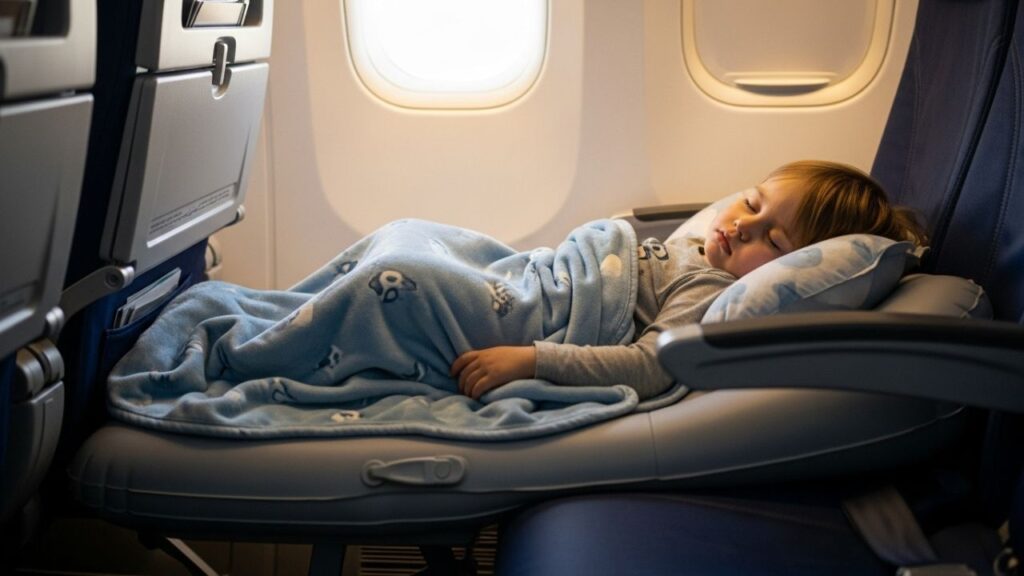
The cramped airplane seat is enemy number one for toddler sleep. But a few smart additions can transform that space into something almost comfortable.
These items address the universal problem of toddlers who can’t get comfortable enough to sleep, which leads to overtired meltdowns. Here’s what actually helps:
Inflatable footrests or airplane beds:
- Create a flat(ish) sleeping surface by filling the gap between seats
- Must be inflatable (TSA-approved, takes up almost no space when deflated)
- Look for models that inflate in under a minute—your toddler won’t wait patiently
Neck pillows designed for toddlers:
- Adult-sized neck pillows don’t fit their proportions
- The U-shape keeps their head from flopping uncomfortably during sleep
- Bonus: doubles as a lumbar support cushion during active hours
Compact travel blankets or sleep sacks:
- Airplane cabins get surprisingly cold
- Familiar textures help signal bedtime
- Wearable sleep sacks prevent blanket tangling and ensure they stay covered
Pro tip: Bring a large muslin swaddle or lightweight scarf. It works as a blanket, nursing cover, makeshift changing mat, sun shade, and emergency burp cloth. It’s the Swiss Army knife of toddler travel.
Volume-Limiting Headphones (Non-Negotiable)
If you’re planning on using screen time—and let’s be honest, you absolutely should—invest in proper toddler headphones before your flight.
Here’s what you need to know about protecting your child’s hearing while keeping them entertained:
Standard adult headphones can damage developing ears. Volume-limiting headphones cap sound at 85 decibels (the pediatrician-recommended safe level) so you don’t have to constantly monitor the volume.
Look for:
- Adjustable headbands that fit 18-month-olds through preschoolers
- Cushioned ear cups (hard plastic gets uncomfortable fast)
- Wired connections (Bluetooth means one more thing to charge, and they can lose connection)
- Airplane adapter compatibility if using the in-flight entertainment system
Cable length matters too. Too short and they can’t move; too long and it becomes a tangling hazard.
Change of Clothes (For Both of You)
Ziploc bags for accidents aren’t just smart—they’re essential for containing the damage when the inevitable happens. And trust me, it will happen.
Pack these clothing items in gallon-sized Ziploc bags to compress them and create instant dirty-clothes containment:
For your toddler:
- Complete outfit including socks and underwear/diaper
- Extra layer (temperatures fluctuate wildly)
- Backup shoes if there’s a major spill (or pack in a separate bag to avoid contamination)
For you:
- Clean shirt at minimum (you will get puked on, spilled on, or smeared with something unidentifiable)
- Consider a spare bra if you’re nursing
The Ziploc method serves double duty: compression for packing and containment for soiled items. Shove the dirty clothes in, seal it, and deal with it later.
Other Gear Must-Haves
A few more items round out your gear checklist. These solve specific but critical problems that pop up during flights:
Sanitizing wipes:
- For tray tables, armrests, and any surface your toddler will inevitably lick
- Larger containers than the tiny travel packs (you’ll go through them fast)
- Check that they’re TSA-compliant if they contain liquid
Plastic bags (multiple types):
- Gallon Ziplocs for dirty clothes, wet swimsuits, half-eaten snacks
- Grocery-sized bags for trash and used diapers when bathrooms are occupied
- Small snack-sized bags for organizing toys and preventing “everything dumped on the floor” chaos
Portable changing pad:
- Airplane bathrooms are disgusting; don’t lay your baby on those surfaces
- Disposable or wipeable options both work
- Compact-fold versions fit in diaper bag side pockets
Mess-Free Snacks for Airplanes: The Food Strategy
Food is your secret weapon. A well-fed toddler is a manageable toddler. A hungry one? That’s when the screaming starts and doesn’t stop.
What You Can Bring Through TSA Security
Let’s clear up the confusion around TSA guidelines for liquids and food items for toddlers, because the rules aren’t as strict as most parents think.
Liquids, purees, and gels for toddlers:
The standard 3.4-ounce liquid rule has an important exception: baby food, breast milk, formula, and juice for children are allowed in “reasonable quantities” exceeding 3.4 ounces. This means you CAN bring:
- Full sippy cups of milk or juice (doesn’t need to fit in your quart-sized liquids bag)
- Pouches of applesauce, yogurt, or purées
- Whole fruits and vegetables with high water content
You must:
- Declare these items separately to TSA officers at the checkpoint
- Remove them from your carry-on for screening
- Be prepared for additional inspection (they may test liquids for explosives)
Pro tip: Freeze juice boxes or milk before leaving home. They’ll thaw during your travel time and keep other items cool, plus TSA considers them solid if they’re still frozen at screening.
The Ultimate Airplane Snack List
Your snack selection needs to check several boxes: non-perishable (or semi-perishable with ice packs), not crumb-creating disasters, individually portioned for rationing, and interesting enough to provide distraction.
Here’s what makes the cut for mess-free snacks for airplanes:
Protein-packed options:
- String cheese sticks (pack with a small ice pack)
- Meat sticks or jerky cut into toddler-sized pieces
- Hard-boiled eggs in a sealed container (yes, they’re allowed)
- Nut butter squeeze packets if your child has no allergies
Fruit options:
- Applesauce pouches (TSA-compliant as mentioned)
- Dried fruit without added sugar (mango, raisins, apricots)
- Freeze-dried fruit crisps (zero mess, huge novelty factor)
- Whole bananas (nature’s perfect packaging)
Crunchy satisfaction:
- Pretzels or pretzel sticks
- Whole grain crackers (look for sturdier brands that don’t disintegrate)
- Veggie straws or chickpea puffs
- Popcorn in individual bags (surprisingly low-mess if they eat from the bag)
Sweet treats (strategically deployed):
- Lollipops (duration matters—these buy you 10-15 minutes)
- Gummy bears or fruit snacks in small portions
- Granola bars that don’t crumble everywhere
- Cookies individually wrapped to prevent the “ate them all in five minutes” scenario
The emergency snack:
Pack one special treat you know your child loves but doesn’t get often. This is your nuclear option for meltdown prevention. When things are deteriorating fast, you bring this out. Make it count.
Feeding Strategy and Timing
Don’t just pack snacks—have a distribution plan. Your goal is to create positive anticipation throughout the flight, which means strategic rationing based on flight length and your toddler’s temperament.
For flights under 3 hours:
- Snack every 30-45 minutes
- Alternate crunchy and soft textures for variety
- Save the “special” snack for descent (ear pressure helper)
For long-haul flights:
- Coordinate snacks around meal service
- Use snacks as transition tools (“We’ll have pretzels after we read two books”)
- Keep a secret stash they don’t know about for emergencies
Bring significantly more than you think you need. If your child normally eats two snacks during a two-hour window, pack five. Boredom increases consumption, and you can always bring leftovers home.
Screen-Free Entertainment and Airplane Activities for Toddlers
Even with iPads loaded with pre-downloaded movies, you need backup plans. Screens fail. Toddlers get overstimulated. Batteries die at the worst possible moment.
The Novelty Principle
The secret to successful airplane activities for toddlers is novelty. Toys they’ve seen a thousand times will bore them in thirty seconds. Brand new items create genuine engagement.
Here’s how to maximize the novelty effect for extended entertainment value:
Wrap individual toys:
- Use tissue paper, gift bags, or even aluminum foil
- The unwrapping itself is an activity
- Creates anticipation and extends engagement time
- Spread out the “unwrapping events” throughout the flight
Dollar store jackpot:
- Hit the dollar store two weeks before your trip
- Buy 10-15 small items (coloring books, stickers, small figurines, pipe cleaners)
- Your toddler has never seen them = maximum novelty
- If they’re lost or destroyed, you’re out three dollars, not thirty
Screen-Free Entertainment Options That Actually Work
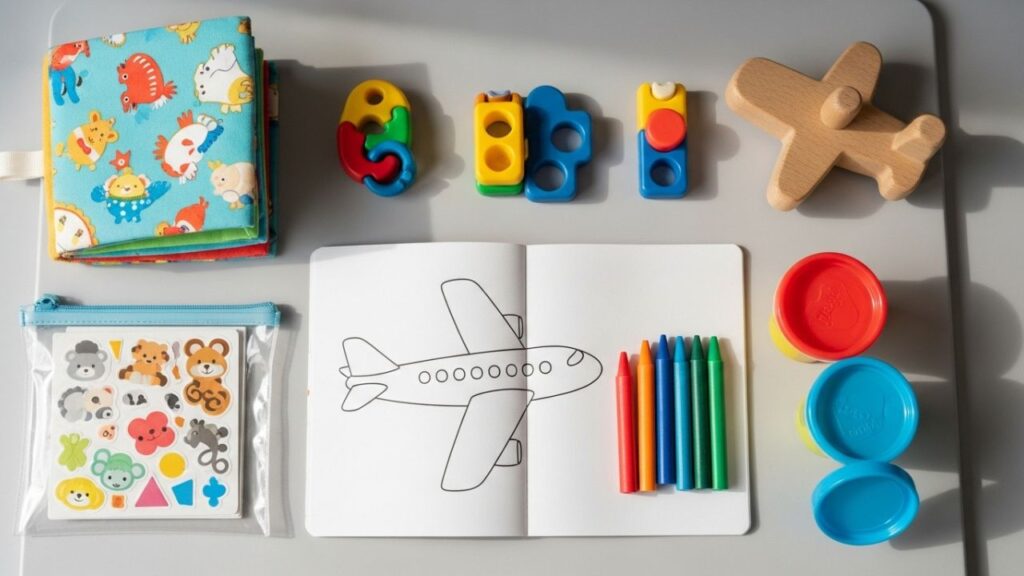
These activities have been tested at altitude and survived the chaos of real flights with real toddlers. They’re organized by the type of engagement they provide.
Fine motor skill activities:
- Sticker books (mess-free and self-contained)
- Reusable water-reveal coloring books (just add water, no markers to lose)
- Pipe cleaners for bending into shapes
- Lacing cards or large beads with string
Imaginative play:
- Small figurines from their favorite shows
- Matchbox cars (bonus: they roll on tray tables)
- Magnetic dress-up dolls
- Finger puppets
Busy bags:
Create 5-6 small activities in individual Ziploc bags. Each bag is a self-contained activity that takes 10-15 minutes. Here are proven winners:
- Bag 1: Foam stickers and construction paper
- Bag 2: Play-Doh in small containers with a plastic knife
- Bag 3: Sorting activity (pompoms and muffin tin, buttons by color)
- Bag 4: Legos or Duplos in a small amount
- Bag 5: Magnetic building tiles (small set)
- Bag 6: Wikki Stix (wax-coated yarn that sticks to itself)
Books:
- Mix familiar favorites with brand new titles
- Board books are sturdier but heavier
- Interactive books with flaps, textures, or sounds
- Consider books about airplanes or travel to contextualize the experience
The Screen Time Strategy
Let’s be realistic: you’re going to use screens. But maximize their effectiveness by following a few rules that make your pre-downloaded movies and apps work harder for you.
Before the flight:
- Download new episodes or movies they haven’t seen (novelty wins again)
- Test that everything plays offline (airport WiFi is terrible)
- Fully charge all devices and bring a portable battery pack
- Load variety: shows, educational apps, mindless games for different moods
During the flight:
- Don’t deploy screens immediately; save them for when other activities fail
- Use screen time as a reward (“After we do the sticker book, we’ll watch one episode”)
- Break up screen time with other activities to prevent overstimulation crashes
- Have audio-only options (podcasts, audiobooks) as a screen break that still feels entertaining
Remember those volume-limiting headphones? Essential here. Your fellow passengers will thank you.
Organization Systems: Making Everything Accessible
The best-packed carry-on in the world is useless if you can’t find what you need when you need it. Organization is what separates prepared parents from frantic ones digging through bags while their toddler screams.
The Three-Zone System
Divide your carry-on into three access zones based on how frequently you’ll need items. This simple framework for diaper bag organization will save your sanity.
Zone 1: Immediate Access (exterior pockets)
- Pacifiers, teething toys, or comfort items
- Hand sanitizer and sanitizing wipes
- Snacks for the current moment
- Phone and boarding passes
Zone 2: Regular Use (top section, easy to reach)
- Diapers and wipes
- Change of clothes in Ziploc bags
- Next rotation of toys/activities
- Sippy cup or water bottle
Zone 3: Deep Storage (bottom of bag)
- Backup supplies (extra diapers, full outfit change)
- Items for later in the flight
- Emergency snacks
- Items you hope not to use (extra plastic bags, backup pacifiers)
Use packing cubes or large Ziploc bags to create sub-sections within zones. This prevents the “everything falls to the bottom” chaos.
The Personal Item Strategy
If you’re traveling with another adult, use your personal item allowance wisely. Most airlines allow one carry-on plus one personal item per passenger.
Adult 1 carries:
- The main toddler supply bag (diaper bag style)
- Focused on immediate needs: diapers, wipes, snacks, first-wave entertainment
Adult 2 carries:
- A backpack with overflow and backup supplies
- Secondary entertainment, change of clothes, extra snacks
- Adult items (phones, wallets, keys, medications)
Traveling solo?
Your personal item should be a small backpack that fits under the seat and contains your own essentials plus the absolute emergency backups. The carry-on overhead bin bag holds the bulk of toddler supplies.
Handling Common In-Flight Challenges
Even with perfect packing, situations arise. Here’s how to handle the most common flying with a 2-year-old scenarios.
Ear Pressure During Takeoff and Landing
Toddlers can’t equalize ear pressure by yawning or swallowing on command. Help them with these techniques that encourage natural pressure relief:
- Nursing or bottle feeding (sucking helps)
- Sippy cups with straws (sipping and swallowing equalizes pressure)
- Lollipops or chewy snacks (jaw movement helps)
- Blow bubbles if you brought a small container (swallowing helps)
Start these activities before the plane begins descent—about 30 minutes out. Don’t wait for your toddler to start crying from ear pain.
The Meltdown Management Protocol
Despite your best efforts, meltdowns happen. When your toddler is in full breakdown mode, here’s the step-by-step response:
- Stay calm (your energy affects theirs)
- Assess needs: Hungry? Tired? Overstimulated? Uncomfortable?
- Change the environment: Walk to the bathroom, switch seats with your partner, adjust their position
- Deploy the nuclear option: The special snack, the new toy, the favorite video
- Accept that it’s happening: Sometimes they just need to cry it out—comfort them and know it will end
Remember: You’ll never see these people again. Do what you need to do to survive.
Diaper Changes in Airplane Bathrooms
Airplane bathrooms are tiny, dirty, and often turbulent. Make changes as efficient as possible with this setup:
- Lay down your portable changing pad (non-negotiable)
- Have new diaper, wipes, and disposal bag ready before removing the dirty diaper
- Work quickly but carefully
- Seal dirty diaper in a plastic bag before putting it in the trash
- Wash hands thoroughly (yours and theirs if possible)
If the seatbelt sign is on and you have a diaper emergency, explain the situation to a flight attendant. They’ll usually let you make a quick change.
The Pre-Flight Preparation Checklist
What you do before the flight matters as much as what you pack. These preparation steps set you up for success before you even arrive at the airport.
One week before:
- Start shopping for novelty toys and activities
- Download movies, shows, and apps
- Check TSA guidelines for any recent changes
- Confirm your airline’s carry-on size limits
Two days before:
- Begin packing carry-on so you can test and adjust
- Prep snacks that can be made ahead (hard-boiled eggs, portioned bags)
- Charge all devices fully
- Print or download boarding passes
Day of travel:
- Feed your toddler a substantial meal before leaving for the airport
- Let them burn energy before boarding (airport play areas are your friend)
- Board during your assigned time (early boarding means more time contained)
- Set up your seat area immediately with essentials in easy reach
Frequently Asked Questions
Q: Can I bring milk or juice through TSA for my toddler?
A: Yes! The 3.4oz liquid rule does not apply to breast milk, formula, cow’s milk, or juice for toddlers. Simply separate these items from your other liquids and inform the TSA officer. They may ask to screen them, but you can bring reasonable quantities.
Q: Should I bring my car seat on the plane?
A: If you bought a seat for your toddler, using an FAA-approved car seat is the safest way for them to fly. It keeps them restrained and comfortable. If you didn’t buy a seat, you will need to gate-check it.
Q: How do I stop my toddler’s ears from popping?
A: The change in cabin pressure during takeoff and landing can hurt. Encourage swallowing by offering a sippy cup, a pouch, a lollipop, or a pacifier during these times.
Q: What if my toddler screams the whole time?
A: Take a deep breath. Most people have headphones on. Do your best to comfort your child, but remember: you will never see these passengers again. You are doing a good job.
Q: What’s the best age to start using toddler airplane bed footrests?
A: Most inflatable footrests work well for children 18 months and older who have their own seat. Before this age, lap-holding is typical. The footrest is most effective when your child can understand staying in their designated space.
Your Flight Day Success Starts With Smart Packing
Flying with a toddler doesn’t have to be the nightmare scenario you’re imagining. When you pack strategically across the three critical categories-gear for comfort, food for stability, and entertainment for engagement-you’re setting yourself up to handle whatever happens at 35,000 feet.
The parents who breeze through flights with seemingly calm toddlers? They’re not lucky. They’re prepared. They’ve thought through the ear pressure moments, the hunger cues, the boredom meltdowns, and the inevitable spills. They’ve packed for the flight they hope to have and the flight they might actually get.
Now it’s your turn.
Ready to ensure you don’t forget anything? Download my free printable “Toddler Airplane Carry-On Checklist” to keep track of everything mentioned in this guide. It’s organized by category, includes checkboxes for packing and re-packing, and fits perfectly in your planning binder or phone. Get your copy here and fly with confidence.