


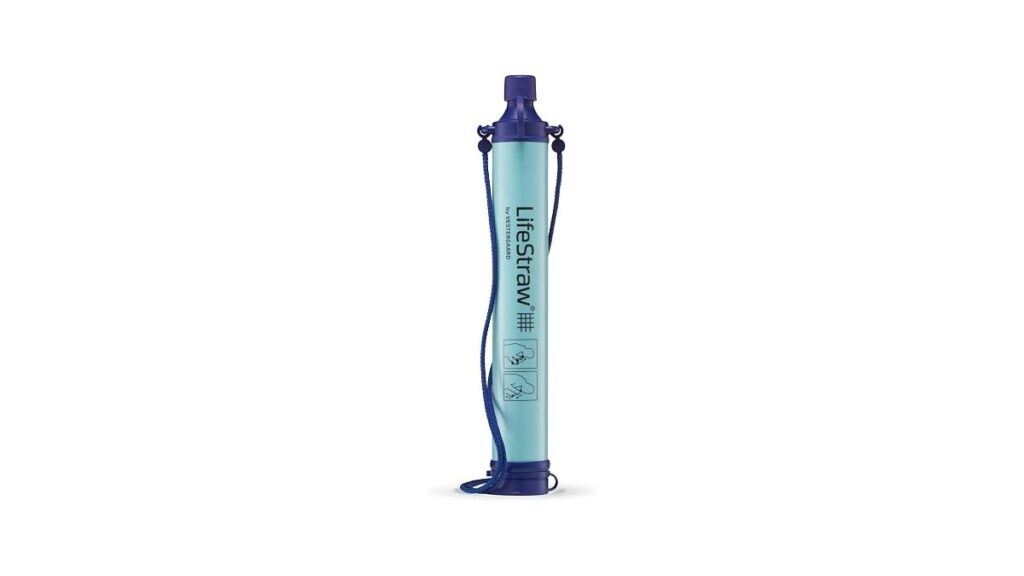
Buy the lifestraw personal water filter if you want one that works by mouth, needs no pumping, and is small enough to live in a pocket or a pack lid on a hike. Skip it if your group needs to fill bottles and pots, because this one is built for a single drinker at a time. That’s the whole trade-off, and it’s worth settling before you read further.
LifeStraw Personal Water Filter for Hiking is a straw-shaped water filter you drink through directly from a stream, lake or tap. The listing leads with three things: a microfiltration membrane that removes 99.999999% of waterborne bacteria and 99.999% of waterborne parasites, a stated capacity of 4,000 liters before it needs replacing, and testing verified against protocols set by the US EPA, NSF and ASTM. Those are the numbers the manufacturer publishes, and they’re the ones this review works from.
The owner this is built around drinks from wild water often enough to want something always at hand. A day hiker topping up at a stream, a backpacker counting grams, someone keeping a bug out bag in a car boot — all three fit, because the filter takes up about as much room as a pen and adds no pumping step. The trade-off is that it serves one person at a time, straight from the source. If your trip means filling bottles for two or more people, you’ll feel that limit on the first hot afternoon. The sections below settle whether it matters for you.
Affiliate disclosure: we take part in the Amazon Associates programme, so buying a product through a link here may earn us a commission. The price you pay stays the same.


Who should buy this filter, and who shouldn’t
Three kinds of buyer get their money’s worth here. The first is the solo day hiker or trail runner who drinks straight from a stream and doesn’t want to stop and unpack anything. The listing’s whole design points at that: you drink through the straw, so there’s no bottle to fill, no pump handle to work and nothing to assemble at the water’s edge. Someone who covers ground fast and drinks on the move is exactly who this suits.
The second is the backpacker watching pack weight. The listing calls it a camping and hiking essential, and the shape is the reason — it’s a personal filter, not a group system, so it earns its place in a pack by being small and light rather than by output. If you already carry a bottle, this sits alongside it without adding a second container to your load.
The third is the emergency planner. The listing names a survival kit and a bug out bag directly, and the 4,000 liter capacity is what makes that sensible. A filter you store and forget needs a long stated life, and this one has it. Someone building a kit for a household, a car or a cabin gets a filter that won’t need swapping out after a season of use.
Two buyers should look elsewhere. If you’re filtering for a group — a family of four, a scout patrol, a campsite kitchen — a personal straw means one person drinking at a time, which turns every water stop into a queue. Look for a gravity or pump system that fills a container instead. And if you want to filter into a bottle to carry, rather than drink at the source, this isn’t shaped for that job.
What the LifeStraw Personal Water Filter gives you
Four jobs, and the listing covers each one with a stated figure. Here’s what each means once you’re actually out there.
Making wild water safe to drink
This is the core job, and the listing is unusually specific about it. The microfiltration membrane removes 99.999999% of waterborne bacteria, including E. coli and Salmonella, and 99.999% of waterborne parasites, including Giardia and Cryptosporidium. Those two categories are the ones that ruin trips — the bacteria that hit you within a day and the parasites that hit you a week later.
What that changes in daily use is simple: a stream becomes a water source instead of a view. You don’t need to carry your full day’s water from the trailhead, and you don’t need to ration. You drink when you’re thirsty, at the water you’re standing next to.
The condition the listing puts on it is that these are the manufacturer’s stated removal rates, verified in laboratories. It’s a microbiological filter, so it’s aimed at organisms, not at chemical contamination or salt.
Cutting out microplastics and cloudiness
The second job is the one people underrate. The listing says the filter removes the smallest microplastics found in the environment, down to 1 micron, and reduces turbidity down to 0.2 microns. Turbidity is the cloudiness you see in a silty river or a pond after rain.
In use, that matters for two reasons. First, cloudy water is unpleasant to drink even when it’s biologically safe, and a filter that reduces turbidity makes a silty source drinkable rather than merely safe. Second, microplastics are in the news and in the water, and a filter that states a 1 micron cutoff for them is addressing something a bacteria-only filter wouldn’t.
The limit is in the wording: the listing says it reduces turbidity, not that it produces perfectly clear water. Expect a visible improvement in a murky source, not a laboratory-clear result. And the micron figures are the manufacturer’s stated performance, not a measurement taken on your local river.
Lasting a long time between replacements
The listing gives the filter a stated life of 4,000 liters, which it also expresses as 1,000 gallons, of clean and safe drinking water. That’s the number that decides how often you buy again, and it’s a big one for a personal filter.
Think about what it means in practice. A liter or two a day on a weekend trip is nothing against that total, so a casual hiker may never reach the end of it. Even a thru-hiker drinking several liters a day gets a long stretch before the filter needs replacing. For a bug out bag, it means the filter you pack this year is still the filter you’re carrying in several years, assuming you store it sensibly.
The listing doesn’t put a shelf life on it, so if long-term storage is your main use, that’s worth checking before you buy.
Buying that does something for someone else
The listing includes a giving claim: for every LifeStraw product purchased, a school child in need receives safe drinking water for an entire school year. It also states the product is made with BPA free materials.
That second point matters more than it sounds. A filter you put your mouth on, and drink through for years, is one you want made from materials the listing is willing to name. BPA free is the manufacturer’s own wording here.
Take it as a stated commitment rather than a guarantee you can audit.
The full list of listed details sits in the table below.
| # | What Amazon lists |
|---|---|
| 1 | Removes Bacteria & Parasites: The Microfiltration Membrane Removes 99.999999% of Waterborne Bacteria (Including E. Coli and Salmonella), and 99.999% of Waterborne Parasites (Including Giardia and Cryptosporidium) – Essential for Your Survival Kit |
| 2 | Removes Microplastics: Removes the Smallest Microplastics Found in the Environment (Down to 1 Micron), and Reduces Turbidity Down to 0.2 Microns – Ideal for Hiking and Camping Essentials |
| 3 | Rigorous Testing: All Claims Are Verified with Laboratories Using Standard Testing Protocols Set by the US EPA, NSF, ASTM for Water Purifiers |
| 4 | Long Lifetime: The Microbiological Purification System Will Provide 4,000 Liters (1,000 Gallons) of Clean and Safe Drinking Water – a Must-Have for Your Bug Out Bag |
| 5 | Make an Impact: For Every LifeStraw Product Purchased, a School Child in Need Receives Safe Drinking Water for an Entire School Year. Essential Camping Accessory Made With BPA Free Materials |
Where this filter is strong, and where it isn’t
Pros
- Stated removal of 99.999999% of waterborne bacteria
- Stated removal of 99.999% of waterborne parasites
- 4,000 liter stated capacity between replacements
- Microplastics down to 1 micron, per the listing
- Made with BPA free materials, per the listing
Cons
- Personal use only — a single drinker at a time


The verdict on the LifeStraw Personal Water Filter
Buy it if you drink from wild water on your own and want the simplest possible way to do it safely. The listing backs that with stated removal rates for bacteria and parasites, a 4,000 liter capacity that outlasts most people’s use, and laboratory verification against US EPA, NSF and ASTM protocols. For a solo hiker, a weight-conscious backpacker or someone stocking a bug out bag, the case is straightforward.
The filter also removes microplastics down to 1 micron and reduces turbidity down to 0.2 microns. Here the stated performance covers the smallest microplastics found in the environment, not just the easy, clear sources.
For the day hiker who stops at a stream twice on a long walk, this is close to ideal, because there’s no setup and nothing to carry beyond the filter itself. You drink, you move on, and the stated capacity means you’re not thinking about replacement for a very long time.
For the emergency planner, the answer is yes with one caveat. The long stated life is exactly what a stored kit needs, but the listing doesn’t give a shelf life, so if the filter is going into a bag you won’t open for years, confirm that detail first.
The group buyer should say no. The central trade-off here is simplicity against output: you get a filter with no moving parts and no pumping, and you give up the ability to serve a group at once. If your trips involve filling bottles for a family, that trade goes the wrong way, and a gravity or pump system that fills a container is what you actually want.
One more thing worth knowing before you buy: the materials are BPA free, and each purchase funds safe drinking water for a school child for an entire school year. Neither changes how the filter performs. Both are worth having if you were choosing between two filters that do the same job.
Related guides
- 10 Best Lightweight Travel Water Bottle Review
- Best Mini Reusable Water Bottles for Sustainable Travel Adventure
- Best Sirui Tripods for Travel
Frequently Asked Questions
Does the filter need cleaning or replacing?
Yes to both, eventually. The listing states a capacity of 1,000 gallons of clean and safe drinking water before the microbiological purification system reaches the end of its stated life.
Can I use it to fill a bottle instead of drinking straight from it?
No, not the way it’s designed. The listing describes a personal filter you drink through, and that’s the job it’s built for. This one is meant for drinking at the source.
What’s in the box, and do I need to buy anything else?
The listing doesn’t itemise the box contents, so check that before you buy if it matters to you. It does confirm the filter itself and its stated performance. You don’t need a pump, a bottle or a chemical treatment to use it. If you want to carry treated water with you, that’s a separate container you’d supply yourself.
Is a personal water filter actually worth owning?
Yes, if you spend time near wild water. The listing states removal of 99.999999% of waterborne bacteria, including E. coli and Salmonella, and 99.999% of waterborne parasites, including Giardia and Cryptosporidium. The US EPA’s drinking water standards set the framework the listing says its testing follows. If you never drink from a stream, a filter earns its place only as emergency kit.
How long can I store it before it needs replacing?
What it does state is a total volume of water treated, which is a measure of use rather than of time sitting in a bag. Those are different things, and only the manufacturer can tell you how storage affects the filter. If you’re packing it into a kit you won’t open for years, confirm that detail before you buy.