


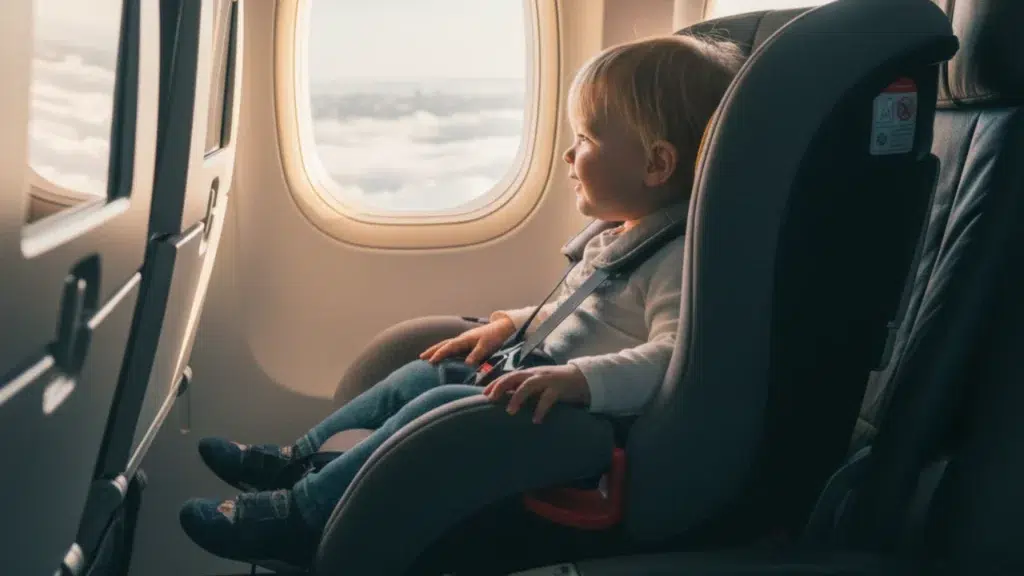
Booking a flight with a toddler feels less like planning a vacation and more like planning a tactical operation. You aren’t just worried about tantrums or dirty diapers; you’re worrying about their actual safety. Will the turbulence be bad? Will their ears hurt? Is my car seat actually allowed on this plane?
I’ve been there—standing in the boarding line, sweaty palms, clutching a boarding pass in one hand and a wriggly two-year-old in the other. It’s normal to feel anxious.
But here is the good news: with the right preparation, flying can be incredibly safe for young children. This guide covers the essential flight safety tips toddlers need to stay secure, comfortable, and happy from the moment you enter the terminal to the moment you touch down. We are going to move past the generic advice and dig into the real safety concerns, like the lap-infant debate, FAA regulations, and protecting those sensitive little ears.
The Big Debate: Lap Infant vs. Buying a Seat
This is the number one question parents ask, and the answer often comes down to budget versus safety. The FAA currently allows children under the age of two to fly as “lap infants” for free (or for a small tax on international flights).
However, just because it is allowed doesn’t necessarily mean it is the safest option.
When we talk about flight safety tips toddlers need, we have to talk about turbulence. In the event of severe, unexpected turbulence, it is physically impossible for an adult to hold onto a child securely. The laws of physics just take over. The FAA and the National Transportation Safety Board (NTSB) both strongly recommend that children ride in a Child Restraint System (CRS) or a car seat in their own separate seat.
Why You Should Consider a Separate Seat
If you are on the fence about spending the extra money, here is a breakdown of why safety experts lean toward buying a ticket for your toddler.
Understanding the risks and benefits of securing your child in their own seat is crucial for making an informed decision that prioritizes their physical safety during rough air.
- Turbulence Protection: A strapped-in child is safe from unexpected drops or bumps that could throw a lap infant into the ceiling or armrests.
- Parental Safety: In an emergency landing, you need your hands free to brace yourself. Holding a child compromises your ability to assume the brace position.
- Comfort Factor: Let’s be honest—holding a squirming 25-pound toddler for four hours is exhausting. A separate seat keeps them contained and gives you space.
Pro Tip: If you absolutely cannot afford a second seat, ask the gate agent if the flight is full. If there are empty seats, they might let you bring your car seat on board for free.
Car Seats, Harnesses, and FAA Rules
If you decide to buy a seat for your toddler (which is the gold standard for safety), you need to know what gear is allowed. You can’t just bring any booster seat on board.
Flying with a Car Seat vs. Checking It
There is often confusion about flying with car seat vs checking it. Checking it as luggage is easier for you to carry through the airport, but it leaves your car seat vulnerable to damage from baggage handlers. A damaged car seat might not protect your child in a car accident later.
Using the car seat on the plane is safer for the flight and ensures your seat arrives at your destination in one piece.
To ensure your car seat is actually allowed on the aircraft, you need to check for specific labeling that flight attendants will look for.
- Look for the Sticker: Your car seat must have a label stating: “This restraint is certified for use in motor vehicles and aircraft.”
- Width Matters: Most economy seats are between 16 and 17 inches wide. If your car seat is massive, it might not fit. Measure it before you fly.
- Window Seats Only: FAA rules generally require car seats to be installed in a window seat so they don’t block the escape path for other passengers.
The CARES Harness Alternative
If lugging a 20-pound car seat through the terminal sounds like a nightmare, look into the CARES harness. This is currently the only FAA-approved harness-style restraint for aviation.
The CARES harness is designed specifically for children who are old enough to sit upright but small enough to need extra protection, usually between 22 and 44 pounds.
- Portability: It fits in a pocket and weighs almost nothing.
- Safety: It creates a 4-point harness (like a car seat) using the airplane’s existing seatbelt.
- Limitations: It is strictly for airplanes; it cannot be used in cars. You will still need a car seat at your destination.
Protecting Little Ears: Preventing Pain
One of the most heartbreaking sounds on a plane is a toddler screaming during descent. This is usually caused by eustachian tube pressure—the inability to equalize ear pressure as the cabin altitude changes.
Adults do this naturally by swallowing or yawning. Toddlers don’t know how to do that consciously, and their ear tubes are smaller and flatter, making them more prone to pain.
Toddler Ear Pain Flying Remedies
You don’t have to feel helpless when the pilot announces the descent. There are proactive steps you can take to force their ears to pop safely.
These remedies focus on encouraging jaw movement and swallowing, which mechanically opens the eustachian tubes and relieves painful pressure buildup.
- Timing is Key: Do not let them sleep through the descent. Wake them up about 30 minutes before landing.
- The Swallow Reflex: Give them a bottle, a pouch, or a lollipop (if age-appropriate) during takeoff and the final 20 minutes of landing. The swallowing action is the best defense.
- The “Fish Face” Game: If they are older, teach them to make funny faces, wiggle their jaw, or fake a big yawn.
- Ear Protection: Some parents swear by “EarPlanes,” which are pressure-regulating earplugs designed for kids.
Safety Note: Avoid using decongestants (like Benadryl) to “knock them out” unless your pediatrician explicitly recommends it. Sometimes these meds can have the opposite effect and make kids hyperactive or increase heart rate at high altitudes.
Navigating the Airport: Pre-Flight Safety
Safety starts before you even board. Airports are chaotic, crowded, and full of distractions. Keeping toddlers safe in airport terminals requires hyper-vigilance.
TSA Family Lane Rules and Security
The TSA actually has specific accommodations for families, though they aren’t always well-advertised. Look for the “Family Lane” at security checkpoints—it moves slower, but the agents are usually more patient with gear.
Knowing exactly what you can bring through security helps you avoid scrambling at the conveyor belt while your toddler tries to run off.
- Liquids Exemption: You are allowed to bring breast milk, formula, juice, and water for toddlers in quantities larger than 3.4 ounces. You just have to declare them to the agent.
- Shoes On: Children under 12 usually do not have to remove their shoes.
- Baby Wearing: You can often wear your baby in a carrier through the metal detector, though they may ask to swab your hands afterward.
Preventing “The Runner”
Toddlers are fast. In a busy terminal, they can disappear behind a luggage cart in seconds.
To prevent separation in a crowded airport, consider using these safety tools and identification methods to ensure your child is easily found if they wander off.
- Child Identification Bracelet: If your toddler isn’t verbal enough to say your phone number, write it on a wristband or a sticker placed on their back (where they can’t peel it off).
- Gate Check Stroller: Keep your toddler strapped in the stroller until the very last second at the gate. It acts as a “toddler cage” to keep them safe from crowds.
- Dress Bright: Put them in a neon yellow or bright orange shirt. It makes them instantly spotting in a sea of grey business suits.
In-Flight Hygiene and Environment Safety
Airplanes are not known for being sterile environments. When you have a toddler who touches everything and then puts their hands in their mouth, hygiene becomes a safety issue.
How to Clean Airplane Seats for Babies
You don’t need a hazmat suit, but a quick wipe-down can prevent your vacation from being ruined by a stomach bug.
Focus on sanitizing the high-touch areas where previous passengers have likely left germs to minimize your toddler’s exposure to illness.
- The Tray Table: This is statistically the dirtiest surface on the plane. Wipe it down immediately with sanitizing wipes before your child touches it.
- The Armrests and Seatbelt Buckle: These are high-contact points that are rarely deep-cleaned by airlines.
- The Window Shade: Toddlers love to lick the window (why? I don’t know, but they do). Wipe the shade and the glass.
Physical Hazards at 30,000 Feet
Beyond germs, the physical environment of a cramped economy seat poses a few risks.
Be aware of these specific mechanical dangers in the cabin to prevent pinched fingers and bumps during the flight.
- Overhead Bin Hazards: Keep your child seated when the plane lands. During the rush to deplane, heavy bags often fall out of overhead bins. You do not want your toddler in the aisle when that happens.
- Window Seat Safety: Ensure fingers are clear of the armrest mechanisms and the window shade track.
- Hot Liquids: Be very careful with hot coffee or tea. A sudden bump of turbulence can spill scalding liquid on a lap infant. It is safer to stick to cold drinks when holding a baby.
FAQ: Common Toddler Flying Questions
You’ve got the basics, but here are a few specific scenarios parents often ask about.
Q: Can I use an inflatable footrest so my toddler can sleep flat?
A: It depends on the airline. Some international carriers allow these “bed boxes,” but many US domestic airlines ban them because they block access to the aisle during an evacuation. Always check the airline’s specific policy page before buying one.
Q: What if my toddler has a tantrum and the seatbelt sign is on?
A: Safety comes first. If the seatbelt sign is on, you must keep them strapped in, even if they are screaming. It is better to have a crying child than an injured one during turbulence. Speak calmly, hold their hand, but do not unbuckle them.
Q: Does the Valsalva maneuver work for toddlers?
A: The Valsalva maneuver (pinching the nose and blowing) is hard for toddlers to understand and can damage their ears if done too hard. Sticking to swallowing (drinking/chewing) is much safer for this age group.
Q: My car seat is too wide for the plane seat. What now?
A: If you board and the car seat doesn’t fit, you will have to gate-check it. To avoid this, measure the base of your car seat at home. If it’s wider than 17 inches, consider buying a lightweight “travel” car seat or using the CARES harness.
Final Thoughts & Next Steps
Flying with a toddler is an endurance sport, but it doesn’t have to be dangerous. By prioritizing a proper restraint system (whether that’s a car seat or a CARES harness), prepping for ear pressure, and sanitizing your space, you are mitigating 90% of the risks associated with air travel.
Remember, the goal isn’t a “perfect” flight where they sleep the whole time. The goal is a safe arrival. You’ve got this.
Ready to pack? Don’t guess on the gear. Click here to download our free “Toddler In-Flight Safety & Packing Checklist“ to make sure you haven’t forgotten the essentials, or view our comparison table of FAA-approved travel car seats to find the perfect fit for your next trip.